Autism CRC logoAutism CRC logo
eNews February 2026

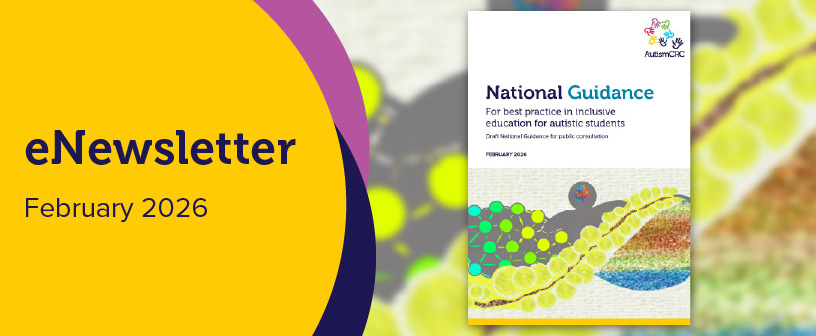
Have your say – Draft National Guidance for Inclusive Education

Last year we reviewed 500 research papers and heard from nearly 800 autistic people and people who support autistic students – thank you! This evidence has been used to draft the National Guidance for best practice in inclusive education for autistic students (National Guidance). Autism CRC is now inviting input from all members of the community to have their say on the Draft.

The National Guidance applies to autistic students in mainstream pre-schools, kindergartens and schools. If you are a teacher, school leader, parent, allied health professional or autistic person with experience in Australian education, we want to hear from you! We also invite organisations that support autistic people or inclusive education to provide feedback.

Consultation closes Sunday 15 March 11:59pm AEST (QLD time).

Find out more and complete survey
Australasian Autism Research Council - Defining national autism research priorities

Announcing the 2026 AARC

We are pleased to announce the membership of the Australasian Autism Research Council (AARC) for 2026. We received over 200 expressions of interest for AARC membership. Interest came from across Australia, with applicants representing a rich and diverse range of experience, perspectives and expertise.

We welcome back members serving again this year and newly elected members Sarah Harvey, Nick Philipson, Jolene Stockman and Dr Olivia Gatfield.

Read more
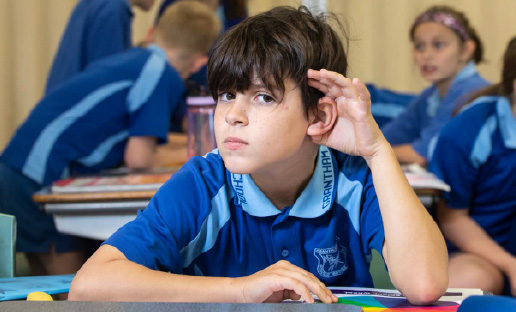
A child sitting in a classroom and holding a hand up to their ear

School is back

To help kick-start 2026, we’ve selected a range of inclusionED resources and practices that can help with organising your classroom to support your students getting into the learning zone.

One of the best things you can do is to conduct a sensory audit of the learning environment with our inclusionED Guide to Classroom Sensory Audits for both primary and secondary educators.

These checklists make it easy to review your classroom’s sensory environment and quickly create a more inclusive, supportive space for all students.

Learn more
National Autism Strategy 2025-2031

National Autism Strategy Reference Group formed

The Department of Health, Disability and Ageing has announced community representatives for the newly formed Strategy Reference Group. The Reference Group will provide strategic advice to the Department on prioritisation and implementation of actions under the First Action Plan. It will advise on the development of the evidence and evaluation framework of the Strategy. The group will also monitor evaluation processes including reporting on implementation and development of future Action Plans.

We congratulate those appointed to the Reference Group and look forward to assisting their work as best we can.

Learn more
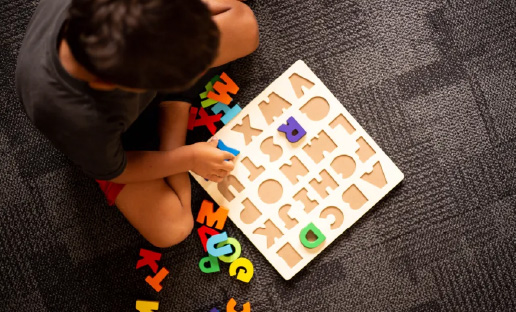
A young child sitting on the floor and working on an alphabet puzzle

Thriving Kids report released

Autism CRC welcomes the agreement between the Commonwealth and state governments on joint-funding to deliver Thriving Kids, along with the Advisory Group report handed down in February​. The program’s design framework has been informed by extensive stakeholder input and best-practice evidence.

Thriving Kids is to deliver general parenting supports, local information, advice and navigation, and targeted supports from allied health professionals and other appropriately skilled workers – based on each child and family’s strengths and support needs. Importantly, Thriving Kids aims at strengthening multiple pathways for early identification of children with developmental delay or differences and connecting them with the right supports.

Learn more
A young child with slightly messy hair facing away from the camera

Biobank data may help us better understand stress

Using data and biological samples from Autism CRC’s Australian Autism Biobank​, new research from Neuroscience Research Australia (NeuRA) and the University of NSW has found hair cortisol levels may complement autism assessments for determining the impact of chronic stress.

The non-invasive biomarker can provide insight into a person's more chronic state of stress and wellbeing. It may be particularly helpful in understanding stress in non-speaking people or those with higher communication support needs.

Read more
A young child with a proud grin holding a tablet with two animated characters standing next to them

Do you know a Secret Agent Society (SAS) Cadet?

Our friends at Social Science Translated are inviting current and past SAS Cadets to share their own custom designs for relaxation gadgets for a chance to win a $100 gift card and help others!

The winning creation could also be incorporated into the SAS Small Group Program and shared with Cadets worldwide.

There is no one-size-fits-all approach to relaxation, and sharing a unique style could help others find what works for them!

Competition closes 8 April 2026.

Learn more
A doctor talking to a young child who is sitting in the lap of their parent

Assessment and diagnosis courses

Enrol today in online microcredentials developed by Autism CRC with The University of Western Australia (UWA). These flexible, self-paced courses provide 1-2 Professional Development Points upon completion, with a Certificate of Achievement and a Professional Development Transcript.

Congratulations to the team at UWA, who were recently recognised for their work on developing and delivering the microcredentials. They received a UWA Team Award for Excellence and Innovation in Learning and Teaching in the Digital Transformation category.

Learn more

The latest published outputs from Autism CRC

Page icon

Publications

  • Reliability and validity of strength-based language modifications to the autism self-efficacy scale for teachers (ASSET)
Resource icon

Resources

  • Draft National Guidance for best practice in inclusive education for autistic students
  • Guide to sensory audits: inclusionED

Established in 2013, Autism CRC is the world’s first national, cooperative research effort focused on autism. We are the independent national source of evidence for best practice in relation to autism across the lifespan and the spectrum.

Follow us

Facebook X, formerly Twitter Youtube Linkedin  

Contact us

+61 7 3377 0600

hello@autismcrc.com.au

If you would like to share something with our network, send us an email.