An overview of participatory research
Key concepts in participatory research
What is participatory research?
Participatory research includes community members throughout the research process, rather than just as research participants (Cargo & Mercer, 2008). Participatory research is sometimes also called “community engagement” or “patient and public involvement”. In autism research, participatory research means that autistic people and their supporters have a say in what research is done, how the research is done, and how the research findings are used. When we talk about “community members” in autism research, first and foremost we are talking about autistic people. When it’s relevant, “community members” can also refer to supporters of autistic people, like their family members and friends, service providers, educators, policy makers, and other relevant people or organisations.
Participatory research has existed for more than 50 years (Arnstein, 1969). Academics in many different fields (including agriculture, mental health, public health, and indigenous cultures) use participatory approaches in their research. Historically, autism research has mostly been controlled by non-autistic researchers and professionals, with some input from parents of autistic children, but very little input from autistic people (Jivraj et al., 2014). This has started to change, and participatory autism research is becoming more common.
Participatory research is a framework, or a way of thinking about research (Cargo & Mercer, 2008). It is not a research method or methodology. Almost any research project could be conducted using a participatory framework. There are no specific rules for how participatory research should work, but there are some key concepts that make participatory research different from other research. The most important concept in participatory research is the idea of sharing power.
Power
Power is a person or group’s ability to have influence or control (Roper et al., 2018). In research, academics usually have most or all of the power, and the people who participate in research usually have very little or no power. This is called a power imbalance.
Researchers usually have control over decisions like:
- which research questions are asked, and which research projects are conducted
- which methods will be used to answer research questions
- who the participants in a research project will be
- what participants will be asked to do
- how research findings will be interpreted
- how research findings will be published or shared
- how research funding will be spent.
In participatory research, the aim is to share power more evenly between researchers and community members (Cornwall & Jewkes, 1995). Ideally, community members should have as much power as researchers, or even more.
When first starting out in participatory research, it can be difficult to figure out how to share power. Academics might be used to having lots of control and making all the decisions in research, and it might be hard for them to give up control. Community members might find research confusing or intimidating, and have trouble speaking up or lack the confidence to take on more control.
Autistic people in particular might not be used to having power. They might be used to living in circumstances that meet other people’s needs, but not their own. They might be used to having other people make decisions for them, or speak for them, even when they don’t want this to happen. This might be especially true for autistic people who are non-speaking or have an intellectual disability. Because of this, in undertaking participatory research you may want to try to give autistic people even more power than everyone else, to make sure that autistic people’s voices are heard (Nicolaidis et al., 2011).
In participatory research, it is very important that researchers and community members work together to reduce power imbalances. Each research team will need to use different strategies to share power, to meet different people’s needs and preferences. Here are some simple strategies that might help to lessen power imbalances between researchers and community members:
- researchers using their first name instead of ‘Dr’ or ‘Professor’
- researchers wearing casual clothes (instead of business clothes) to meetings
- holding meetings at a location that suits the community members instead of the researchers (for example, a low-sensory environment instead of a university campus)
- holding meetings in a way that suits the community members instead of the researchers (for example, text-based meetings through online chat, rather than Zoom or face-to-face)
- writing documents in plain English as well as, or instead of, academic language
- making decisions by voting, or using another strategy that ensures everyone has a say in the decision
- paying community members fairly for their time.
Although the above strategies might help to reduce power imbalances, they are unlikely to be enough on their own to achieve an equal balance of power between researchers and community members. To achieve an equal balance of power, researchers and community members will usually need to work together over time, trying a range of different strategies to figure out which ones work best for them (Roper et al., 2018).
Building and maintaining trusting relationships
To enable effective participatory research, it is important to establish strong working relationships between everyone involved in the research process. Different team members need to feel like they can trust each other. When everyone in the team trusts each other, they will be able to work together more effectively (Jagosh et al., 2015). This might include:
- trusting other team members to do tasks on their own
- feeling comfortable to share opinions openly
- feeling safe asking for support or accommodations
- being able to disagree with other team members without worrying about consequences.
Trusting relationships can help to make power-sharing easier. When academics trust the community members they work with, they will feel more comfortable sharing control of the research process with those community members. When community members trust the academics they work with, they will feel more comfortable about speaking up and taking control.
For autistic people, it might be particularly difficult to trust researchers. In the past, some researchers treated autistic people very badly, and as a result many members of the autistic community are distrustful of researchers (Raymaker, 2019). Even today, some researchers treat autistic participants poorly, and some autistic people have had bad experiences with research (e.g., Lory, 2019; Pellicano et al., 2014). This means that researchers may need to work even harder to earn autistic people’s trust.
Some strategies that might be useful for building trust between team members include:
- team-building exercises
- activities to identify shared goals
- actively listening and treating each other with respect
- making sure to follow through on team decisions
- keeping in regular contact
- having fun together
- regularly evaluating the collaboration and taking steps to improve.
The best way to develop a trusting relationship is to establish and maintain a working relationship over time (Cargo & Mercer, 2008; Nicolaidis et al., 2019). Often, researchers who want to work with autistic people will design a research project, get funding for the project, start running the project, and then ask autistic people to join in. For example, they might advertise for autistic people to be members of an advisory group. This can work for some research projects, but it isn’t always the best approach for good participatory research, as shown in Figure 1.
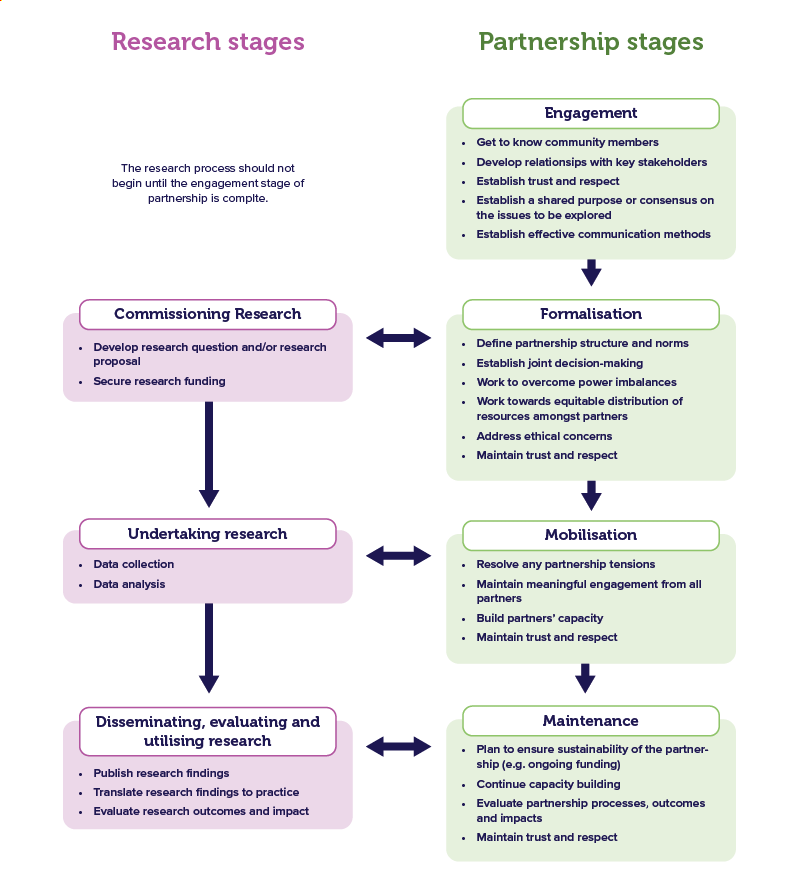
A better approach is for researchers and community members to get to know each other first, before any work happens on a research project (Cargo & Mercer, 2008). Then, they can work together throughout the whole research project, as shown in Figure 2.
Figure 1. Community engagement in a traditional research process
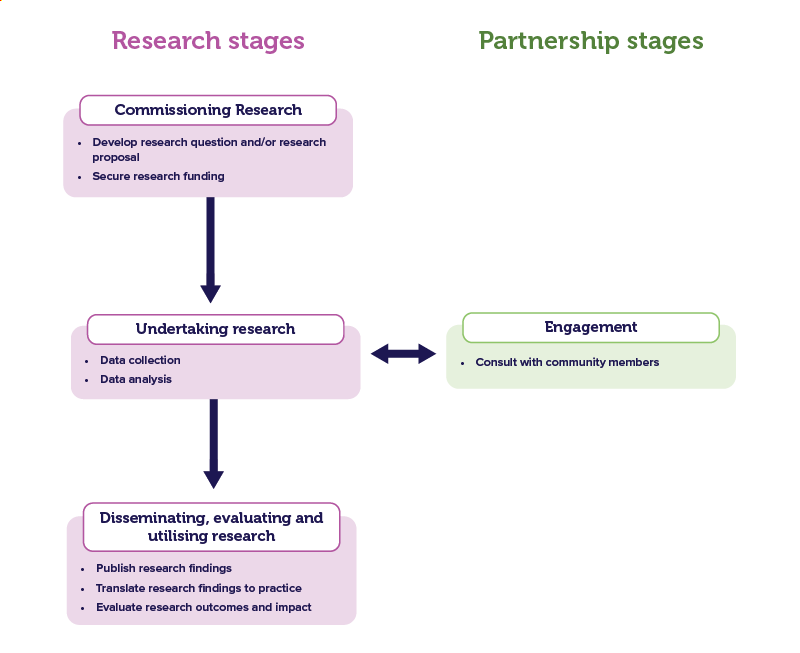
Figure 2. Community engagement in a participatory research process
Stakeholders’ roles
Different people have different roles in participatory research. Each person’s role will depend on their individual knowledge, skills, and experience (Tritter & McCallum, 2006). Usually, a researcher’s role is to provide research expertise. This might include:
- knowing how to apply for research funding
- understanding the relevant evidence base
- knowing how to apply for ethical approval
- making sure a research project is scientifically sound
- knowing how to collect and analyse data
- knowing how to publish research findings.
Usually, a community member’s role is to provide lived expertise and connection to the relevant community (Pellicano & Stears, 2011). This might include:
- knowing which research topics are important to the community
- making sure a research project is relevant to, and respectful of, the community
- making sure the research tools (like surveys or interview questions) are accessible to the community
- promoting the research within the community
- communicating research findings to the community.
There are a range of different stakeholders in the autism community who might act as community members in participatory research. Community members can be individual people, or representatives of an organisation. The foremost stakeholders in the autism community are autistic people, and representatives of autistic-led organisations. Other relevant community members include parents, friends, and family members of autistic people; service providers and other non-academic professionals; government agencies; policy-makers; and corporate organisations.
It can be helpful for community members to understand the research process and have some research skills, but this isn’t essential for participatory research. Sometimes, a lay opinion might be more useful than an academic opinion – for example, to make sure research is accessible to a wide audience. It is important that everyone in the research team understands what knowledge, skills, and experience each person brings to the research project. The team can then work together to decide what each person’s role will be. Establishing clear roles at the beginning of a research project can help to make sure that the project is carried out as planned, and help each person understand and respect each team member’s contribution to the project (Nicolaidis et al., 2019).
How do I engage community members?
The role that community members have in participatory research is very different from the role of research participants, and so there should be different standards for recruitment. When academics are recruiting research participants, they may try to gather a random or representative sample of the population. When academics are choosing other researchers to collaborate with, though, they don’t choose a random sample from the whole population of researchers. Instead, they choose people who have the knowledge, skills, and experience needed for their project (Nicolaidis et al., 2019). Often, researchers will choose collaborators who they already know and get along with, because they recognise that good working relationships with other researchers are important.
When engaging community members in research, it is best to work together with community representatives to collaboratively decide which stakeholder groups should be engaged in the research project, and who should represent those groups. Decisions about who is involved should be based on the knowledge, skills, and experience that they will bring to the project, the time and energy they are able to commit, and any existing working relationships.
Because a community member’s role is to provide lived expertise, we should engage with community members who have lived experience that is relevant to the research topic. Sometimes there may be more than one group of community members with relevant lived experience, and it can be useful to engage representatives of all these groups. For example, in a research project examining home-schooling for autistic students, a range of community members might be relevant: autistic students; parents of autistic students; educators of autistic students; autistic adults who were home-schooled; and education policy-makers. In contrast, in a research project examining autistic women’s identities and self-esteem, autistic women might be the only relevant community members, and it may be inappropriate to engage with other groups.
Some researchers may be new to the autism community, and/or may not have any established relationships with autistic people and other community members. Some strategies for beginning to build relationships with community members include:
- contacting Autism CRC’s Sylvia Rodger Academy to be put in touch with alumni from the Research Program, Future Leaders Program, and Governance Program
- contacting autistic led-organisations like the Autistic Self-Advocacy Network of Australia and New Zealand (ASAN-AuNZ) and the I CAN Network
- contacting autism-specific organisations and service providers, including the various state-based autism peak bodies
- posting on social media using hashtags like #AskingAutistics, #Autistic, #Autism, and #Neurodiversity.
What about autistic academics?
Autistic researchers who conduct autism research can be considered insider-researchers – that is, researchers who are members of the group that they are studying (Greene, 2014). Some of the key issues associated with insider research are similar to those in participatory research - for example, navigating power dynamics.
In participatory research, though, an important part of a community member’s role is to provide a lay (i.e., non-academic) perspective on the research. An autistic researcher who has academic training will be able to provide an autistic perspective on a research project, but their perspective is likely to be influenced by their academic knowledge. This means that an autistic researcher might not be well-placed to perform some of the key roles of a community member, such as making sure that the research is accessible to the autistic community.
Because of this, it is important to involve lay autistic people in participatory research, and not to rely only on autistic academics to act as community members. Autistic academics can be valuable members of participatory research teams, but they should be involved as well as – not instead of – lay autistic people.
Levels of community participation in research
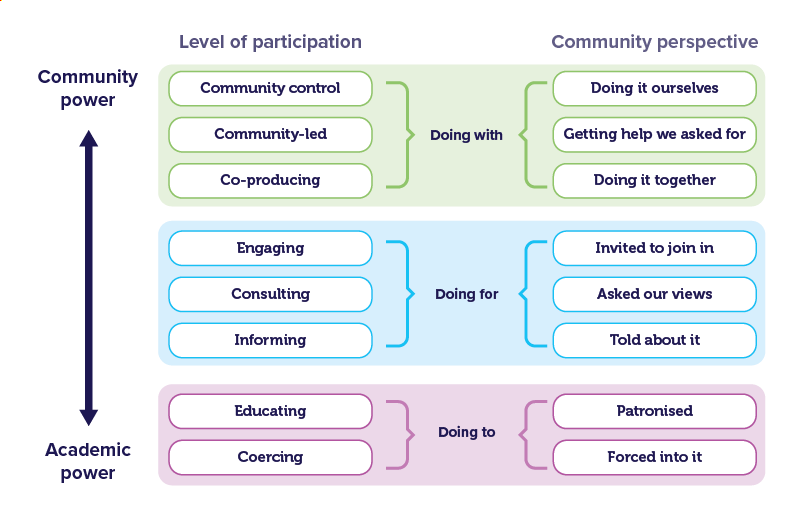
Community members can be involved in research at a range of different levels. The different levels of community participation describe how much involvement a community member has, and how much power they have in the research process (Arnstein, 1969). Figure 3 shows the different levels of community participation in research.
Figure 3. Levels of community participation in research.
Coercion
The lowest level of community participation is coercion. This is when community members are forced to participate in research or convinced to participate when they don’t want to. An example of coercion might be a service provider conducting research to test how effective their services are, and telling clients that they won’t be able to access services any more if they don’t participate in the research. Coercion is unethical and research at this level is never appropriate.
Educating
The next level of participation is educating. At this level, researchers believe that the community needs their help, and try to teach, ‘fix’, or ‘cure’ the community members. An example of educating might be a group of non-autistic researchers who develop and test an intervention program designed to teach autistic children not to stim (i.e. rocking, hand-flapping, and other repetitive behaviours). Research at this level is rarely appropriate, as it is focused on the researchers’ priorities rather than the community’s priorities.
Informing
At the informing level, researchers believe that the community could be interested in research, so they tell the community about their research to help them understand. Researchers might explain what their research is, why they’re doing it, how they’re doing it and what the outcomes of the research are. An example of informing might be a researcher who visits a local community group to give a presentation on their research. Research at this level might be appropriate when the community is interested in the research, but does not have the time or capacity to be involved in producing it.
Consulting
The next level of participation is consulting. At this level, researchers invite the community to give feedback and suggestions for the research. Researchers are still in control of the research, and they can choose whether to take on the suggestions or not. An example of consulting might be a researcher who sets up an advisory group of autistic adults to give feedback on a research project. The researcher may make some changes to the project based on the advisory group’s feedback but ignores other suggestions. Research at this level might be appropriate when a researcher is just getting started in participatory research, when community members don’t have much experience in research or when community members don’t have a lot of time to be involved in the project.
Engaging
At the engaging level, researchers initiate the research project and invite the community to work with them to do the research. Once the community has joined the project, researchers and community members work together, sharing power and control of the research. An example of engaging might be a non-autistic researcher who wants to understand autistic adults’ social experiences. The researcher conducts background research, writes a research proposal, and gets funding to run the project. They then invite three autistic adults to join the research team, and all four team members work together to design a survey, analyse the data, and write reports. Research at this level might be appropriate when a researcher needs to get funding before they can pay community members for their time.
Co-producing
In co-production, researchers and community members work together as equal partners from the beginning of the research process. Researchers and community members jointly agree on a research question to answer, and together they design and conduct the research project. Researchers and community members share power and control all throughout the research process. An example of co-production might be a non-autistic researcher and an autistic person who know each other, and are both interested in understanding the differences between autistic and non-autistic social skills. Together they come up with an idea for a research project, write a proposal, and get funding for their project. They work together to produce the research, making all the important decisions jointly. Research at this level might be appropriate when the researcher has some previous experience of participatory research, and the community members want to be very involved in the research.
Community-Led
The next level is community-led research. In community-led research, the community comes up with an idea for a research project and invites researchers to help them produce the research. The community might need lots of help from researchers, all throughout the research process; or they might just need help occasionally with certain tasks. An example of community-led research might be an all-autistic organisation that runs educational workshops for autistic people and wants to find out if their events are beneficial. They ask a researcher for advice on the best way to investigate this. The researcher helps the organisation to design a study, and they work together to get funding and ethical approval for the study. The organisation gathers data and the researcher gives advice on how to analyse the data. The organisation writes and publishes a report on their findings. The organisation makes all the decisions about the research, taking into account the researcher’s advice. Research at this level might be appropriate when it is important for the community to have lots of power, but the community doesn’t have enough research experience to run the project by themselves.
Community Control
The highest level of participatory research is community-controlled research. In community-controlled research, the community comes up with an idea for a research project and produce the research by themselves. People who aren’t community members aren’t involved in the research process at all, except maybe as participants. An example of community-controlled research might be, as above, an all-autistic organisation that runs educational workshops for autistic people and wants to find out if their events are beneficial. Using their own funds, the organisation designs a research project and gets ethical approval for the study. They gather and analyse the data themselves, and write and publish a report on the findings. The organisation independently makes all the decisions about the research. Research at this level might be appropriate when the community members who will run the project have lots of research skills and experience.
Participatory research in practice
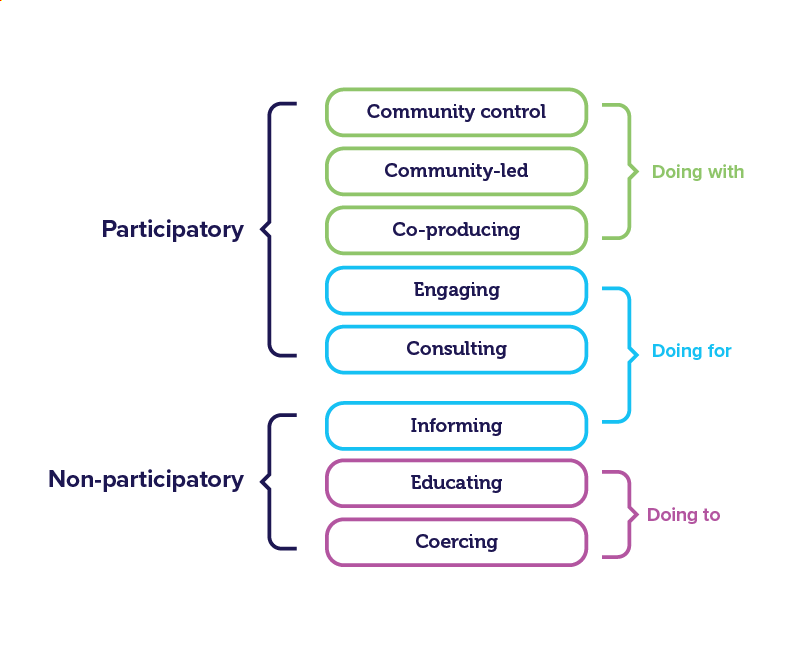
The phrase participatory research usually refers to research at the “consulting” level or higher. At the bottom three levels – coercion, educating and informing – community members are not involved in producing the research, so these levels do not fit the definition of participatory research (as shown in Figure 4).
In a participatory research project, we should aim for the highest level of community participation that is realistic and achievable for our project. This will be different for different research projects.
It is important to note that one research project might have different community members involved at different levels, or at different times during the project. For example, a project could be co-produced by an autistic person and a non-autistic researcher, and also have an advisory group of autistic people who consult on the project. The same project might also have autistic participants who aren’t involved in producing the research but are informed about the project. This is okay, as it is not always practical for everyone in a research project to be involved at a high level, and different people will have differing preferences about how much they want to be involved in research (Tritter & McCallum, 2006).
Figure 4. Participatory and non-participatory levels of community engagement in research.
Participatory methodologies
Participatory research is a framework, not a research methodology or method. Almost any research project, methodology or method can be conducted in a participatory way. It might be more difficult to involve community members in some types of research, like biomedical research, but it is still possible, important, and beneficial. For example, participatory research is becoming increasingly common in clinical trials (including randomised controlled trials) in health research (Crocker et al., 2018).
There are, however, a number of specific methodologies that are inherently participatory. Research using these methodologies must involve community members. Two of the most common participatory methodologies are Participatory Action Research and Community-Based Participatory Research.
Participatory Action Research (PAR)
PAR is a research methodology that involves cycles of planning, acting, observing and evaluating, with the goal of learning about and improving practice (McTaggart, 1991). There are a small number of examples of PAR used in autism research, primarily in educational settings (see Bevan-Brown et al., 2008; Lam et al., 2020; Ostmeyer & Scarpa, 2012; Vincent et al., 2016). PAR is informed by the following key principles:
- PAR is participatory, involving community members in most aspects of the research and action
- PAR is cooperative, with community members and researchers both contributing their expertise to a collaborative process
- PAR is a co-learning process, through which both community members and researchers develop knowledge
- PAR is a method for developing competency and capacity within an existing system or community
- PAR is an empowering process, through which community members gain increased control over their own lives
- PAR achieves a balance between research and action (Israel et al., 1992; Minkler, 2000).
Community-Based Participatory Research (CBPR)
CBPR is used mostly in research with marginalised and minority communities. There are a small number of examples of CBPR in autism research, most conducted by the Academic Autism Spectrum Partnership in Research and Education (AASPIRE; see Nicolaidis et al., 2016; Nicolaidis et al., 2015; Nicolaidis, Schnider, et al., 2020; Nicolaidis, Zhen, et al., 2020; Raymaker et al., 2019; Raymaker et al., 2020). CBPR is informed by ten key principles:
- CBPR recognises community as a unit of identity
- CBPR builds on strengths and resources within the community
- CBPR facilitates collaborative, equitable partnership in all research phases and involves an empowering and power-sharing process that attends to social inequalities
- CBPR promotes co-learning and capacity building among all partners
- CBPR integrates and achieves a balance between research and action for the mutual benefit of all partners
- CBPR emphasises public health problems of local relevance and ecological perspectives that attend to the multiple determinants of health and disease
- CBPR involves systems development through a cyclical and iterative process
- CBPR disseminates findings and knowledge gained to all partners and involves all partners in the dissemination process
- CBPR requires a long-term process and commitment to sustainability
- CBPR addresses issues of race, ethnicity, racism, and social class and embraces ‘cultural humility’ (Israel et al., 2018, pp 32-34).
Less common participatory methodologies include: empowerment evaluation; cooperative inquiry; appreciative inquiry; decolonising methodologies; and, emancipatory methodologies.
Why is participatory research important?
Participatory research has lots of important benefits. However, there are also challenges that can make it difficult to do high-quality participatory research. Some of these benefits and challenges are explained below.
Benefits
- It is morally and ethically right. Like the disability advocacy slogan says, there should be “nothing about us, without us!” Participatory research gives the people who will be most affected by research a chance to shape the research that is done about them (Cargo & Mercer, 2008).
- It produces research that is more relevant and beneficial to the community. Participatory research tends to answer the research questions that are most important to the community and produces outcomes that are more helpful to the community (Brett et al., 2014; Forsythe et al., 2019).
- It improves participant recruitment. When research is designed together with the community, it tends to be easier to recruit community members to join the research as participants (Crocker et al., 2018).
- It is capacity-building for the community, meaning that it allows community members to gain skills and learn something new (Roper et al., 2018). They might learn broad research skills, like how to design a research project, and also more specific skills such as how to use a particular computer program. Over time, community members may gain enough skills to undertake community-led or community-controlled research.
Challenges
- It is almost always more time-consuming. Building relationships between community members and researchers is a very important part of participatory research, but it can take a long time. Participatory research might also involve more people and more steps than non-participatory research - for example, sending documents to an advisory group for feedback is an extra step that takes time (Blackburn et al., 2018; den Houting et al., 2021).
- It is almost always more expensive. Involving community members in research means that those community members should be paid for their time. This is an extra expense that non-participatory research does not have (Blackburn et al., 2018; den Houting et al., 2021).
- It does not fit within current research systems. The way that most research organisations (like universities) think about research does not take participatory research into account. This means it can be difficult to explain participatory research to ethics committees (Nicolaidis et al., 2019) and it can be difficult to get funding for participatory research projects.
- There is a risk of tokenism (Nicolaidis et al., 2019). Because participatory research is becoming more popular, there is a risk that some researchers might set up ‘advisory groups’ so they can claim that they did participatory research, but not listen to the advisory group’s input.
- Some community groups might be underrepresented. It is possible to make participatory research accessible for just about everyone, but some groups are easier to include than others (Ocloo & Matthews, 2016). For example, researchers might need to make lots of changes to how they work in order to involve non-speaking autistic people and autistic people with intellectual disability in participatory research.
Which level of participation is right for my project?
There are a lot of factors to consider when deciding what level of community participation might be right for a particular research project. Some of these factors are discussed below.
- Your own status as autistic or non-autistic. If you are an autistic researcher or community member, you may be able to conduct community-led or community-controlled research. If you are a non-autistic researcher, it is likely that co-production will be the highest level of participation you can achieve (unless you are asked to help with community-led research).
- Your previous experience with participatory research. If you have never conducted participatory research before, consultation can be a good way to gain experience working with community members. If you have had some experience conducting participatory research, consider building on that experience by aiming for a higher level of community involvement.
- Your connection to the autistic community. Depending on your personal and professional background, your level of involvement with the autistic community will vary. If your connection to the autistic community is limited, consultation can be a good way to meet autistic people and start to develop relationships with community members. If you have established networks within the autistic community, consider building on those relationships to form co-production partnerships. If you have well-established, equitable and trusting relationships with one or more autistic colleagues, you are ideally placed to co-produce research.
- Project status. To achieve the highest levels of community participation, it is important to work with community members as early as possible in the research process. If you don’t yet have a research idea or plan, you could co-produce by developing an idea together with community members. If you are already planning a project or in the very early stages of research, you could invite community members to engage in the research. If you have progressed past the early stages of the research project, consultation is likely the highest level of participation that you can achieve.
- Community members’ capacity. Community members will have different levels of capacity for involvement depending on their interest in the project, their availability, their skill set and so on. It is important to discuss expectations regarding level of participation with each community member and jointly agree on the most appropriate level of involvement for each person.
- Your level of comfort with co-production principles. Some elements of co-production can be challenging, particularly when you are new to participatory research. If you are used to having a lot of power and control in research, sharing power with community members may feel very uncomfortable. This is normal! As long as you are willing to work through any discomfort that you may feel during the research process, you can consider co-production. Alternatively, you can consider consulting until you become more comfortable working together with community members.
- Timeframe and budget. Very tight timeframes and/or budgets can make it challenging to achieve a high level of community engagement. In these cases, consultation may be more appropriate. When timeframes and/or budgets are more flexible, consider aiming for higher levels of participation. If you are early in project planning and do not yet have a set timeframe and/or budget, consider co-producing the research and factor in any additional time or budgetary costs associated with co-production in your planning going forward.
- Systemic factors. You may encounter systemic factors that influence the level of community participation you can achieve. For example, some funding bodies and/or Human Research Ethics Committees may not allow community members to be named as Chief Investigators/Principal Investigators in relevant applications. To achieve equitable co-production, you may need to consider implementing strategies within your team to counteract any power imbalance imposed by systemic factors.
Downloadable resources
Download the figures that the explain how particpatory and inclusive research works.
Download