Help advance our understanding of how biological and environmental factors are linked to autistic health and wellbeing.
The Australian Autism Biobank is Australia’s largest collection of data and samples from autistic children and their families.
This page outlines how researchers can apply to use resources from the Australian Autism Biobank for approved research purposes. The Biobank includes biological samples and data (including whole genome sequencing), and behavioural, socio-economic, and health data from internationally-validated tools and questionnaires. This page contains a breakdown of participant numbers, sex and age groups, a link to the applications page, and a sample of the latest publications and resources from research projects using Biobank data and samples.
Watch the video for an overview of opportunities for autism research using the Australian Autism Biobank.
Almost 3,000 people participated in the Australian Autism Biobank.
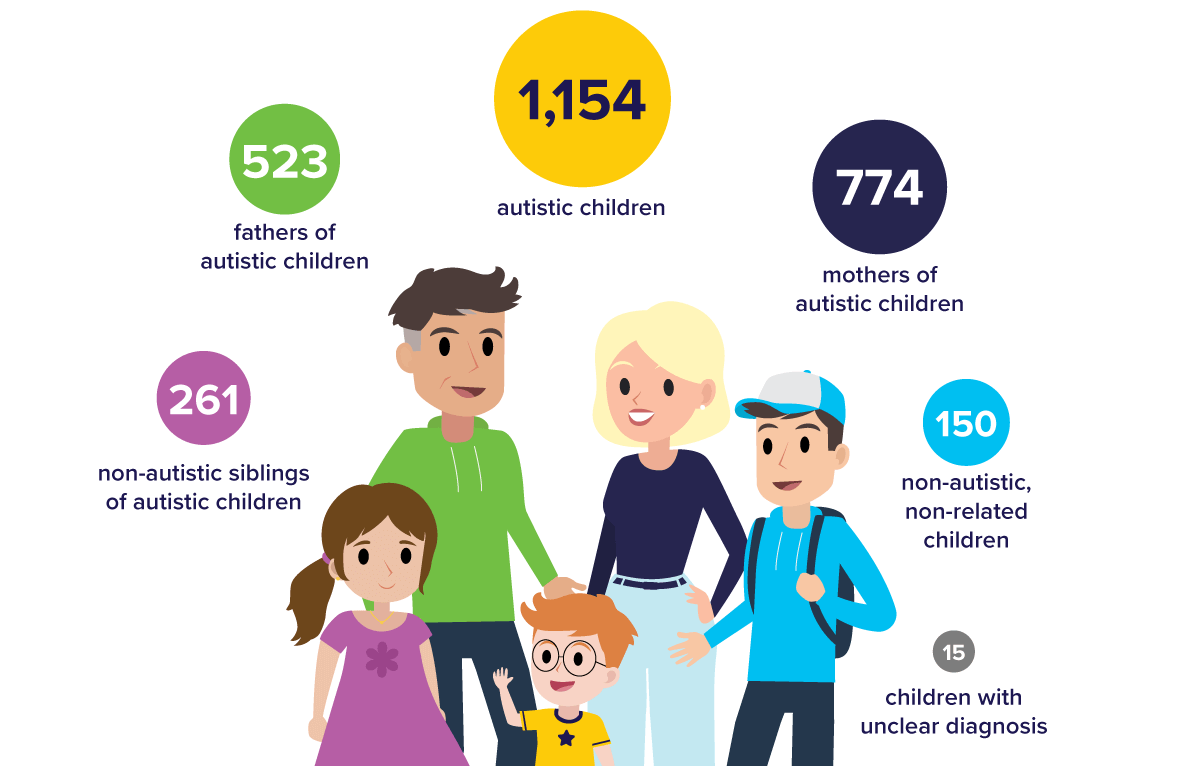

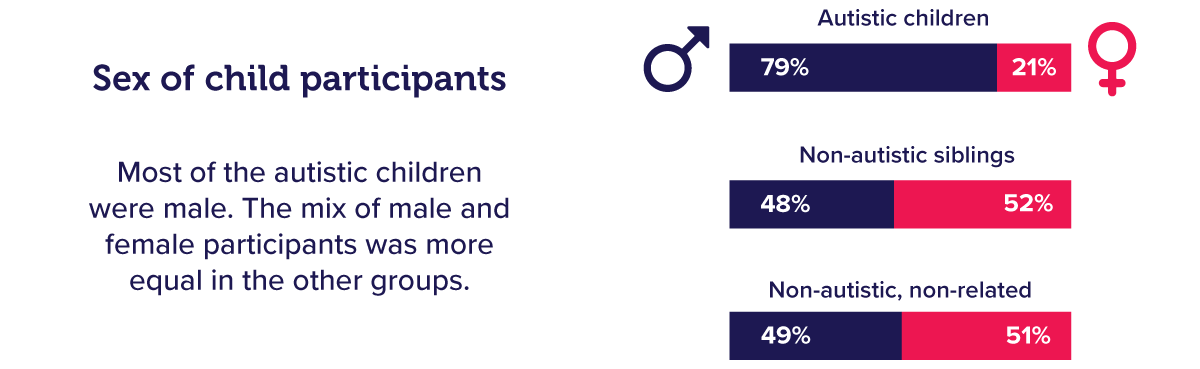
Almost 3,000 people participated in the Australian Autism Biobank.
Age of child participants
Most of the children that participated were 5-12 years old.

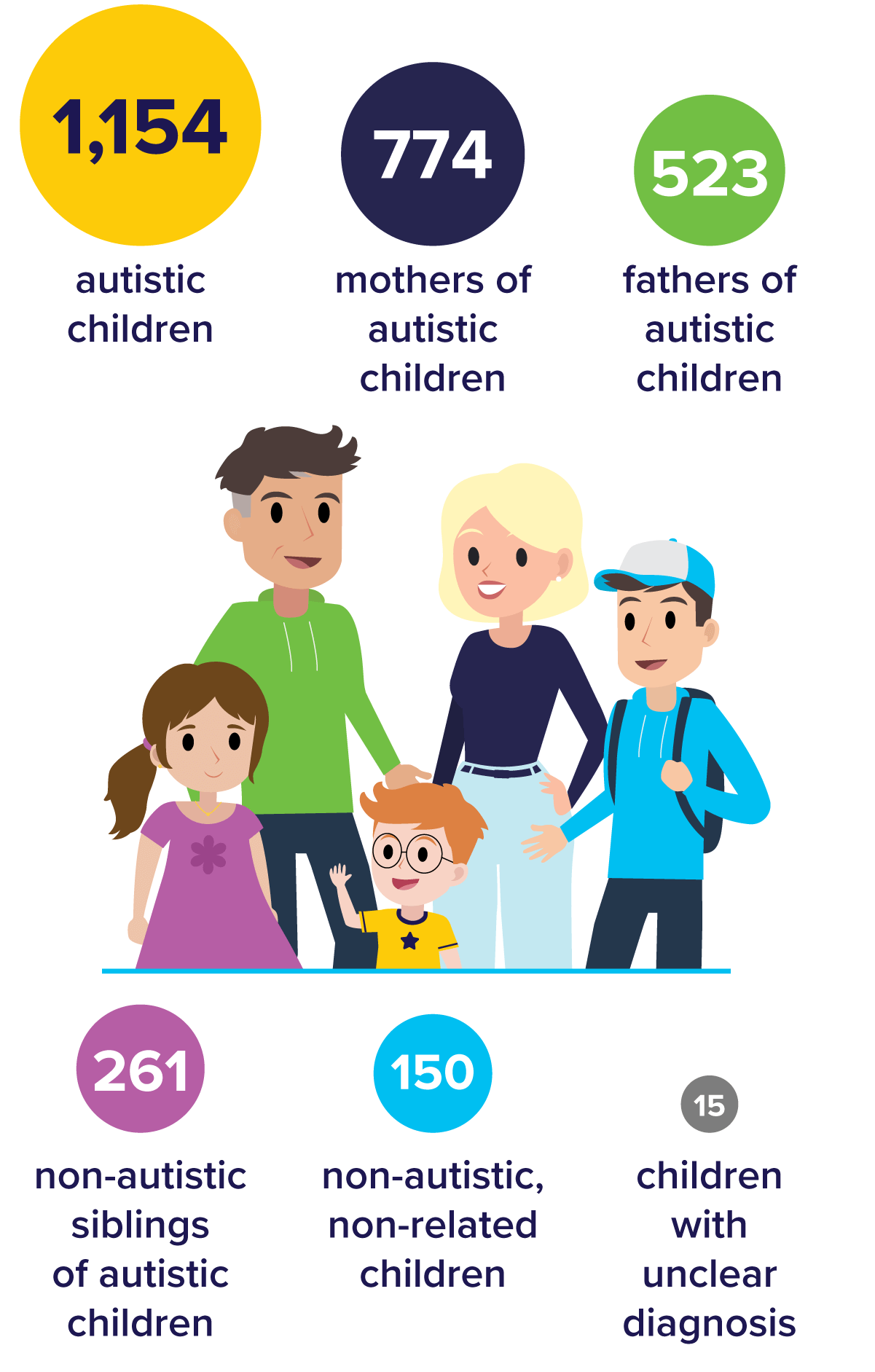
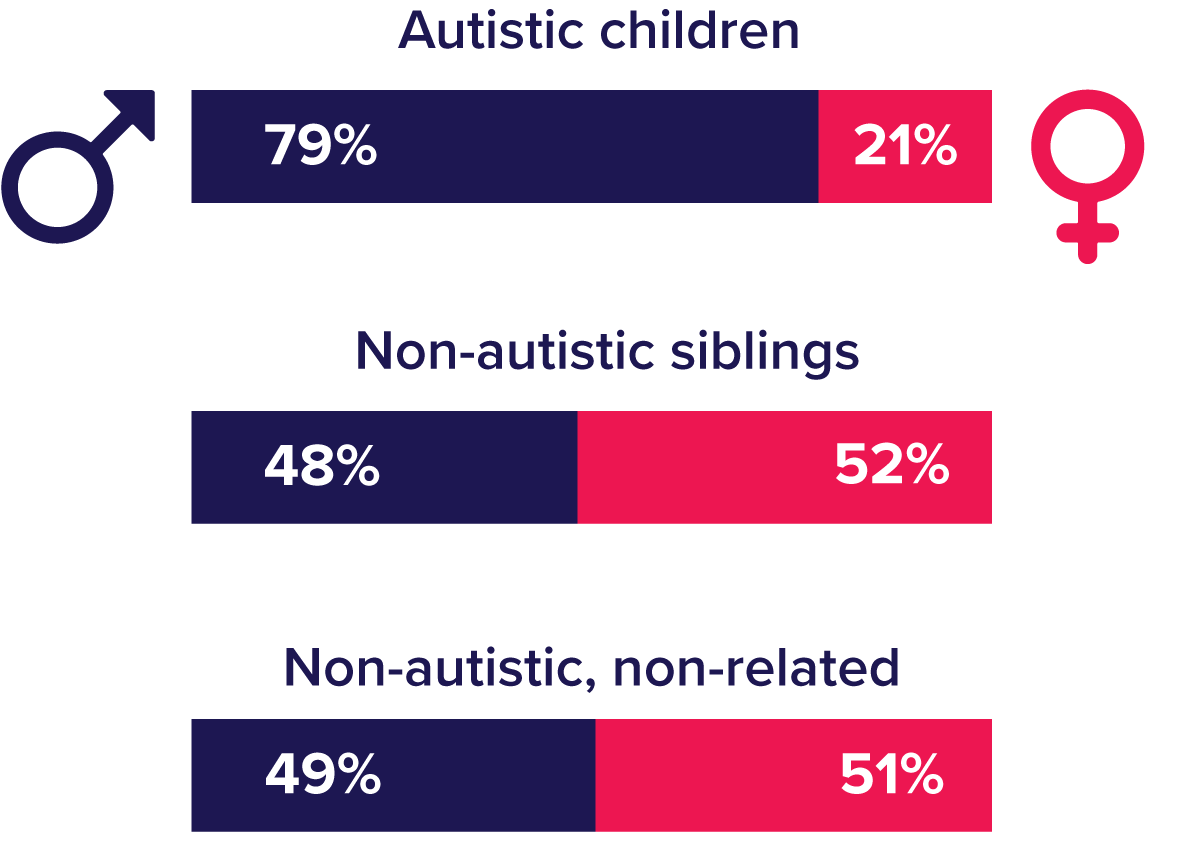
Sex of child participants
Most of the autistic children were male. The mix of male and female participants was more equal in the other groups.
Using the Australian Autism Biobank
All applications are considered by the Autism CRC Access Committee. You can find out how to apply, and what data and samples are available, on the application process page.
What data is available
The following tables give a brief overview of the samples availability and categories. More detailed information can be provided during the application process.
Table 1: Phenotypic data.
|
Category |
Dataset | Short name | Mother* | Father* | Proband | Sibling | Control |
|---|---|---|---|---|---|---|---|
|
Diagnostic Assessments |
Autism Diagnostic Observation Schedule – 2 (Mod 1 -4) |
ADOS |
1125 |
1 |
|||
|
The Developmental, Diagnostic, and Dimensional Interview |
3DI |
785 |
|||||
|
Cognitive Testing |
Mullen Scales of Early Learning (2 – 5 yrs 11 months) |
MSEL |
419 |
84 |
85 |
||
|
Wechsler Intelligence Scale for Children – 4th ed (6-17 years) |
WISC |
436 |
151 |
61 |
|||
|
Wechsler Abbreviated Scale of Intelligence – 2nd Edition |
WASI-I |
726 |
457 |
||||
|
Questionnaires |
Vineland Adaptive Behaviour Scales 2nd Edition |
VABS |
878 |
||||
|
Family History Questionnaire |
FHQ |
1025 |
235 |
129 |
|||
|
Child Development Questionnaire |
CDQ |
||||||
|
Children’s Communication Checklist |
CCC |
772 |
|||||
|
Communication Checklist – Adult |
CCA |
650 |
608 |
28 mothers, 26 fathers |
|||
|
Broad Autism Phenotype |
BAP |
756 |
738 |
115 mothers, 115 fathers |
|||
|
Social Responsiveness Scale |
SRS |
50 |
175 |
123 |
|||
|
Short Sensory Profile – 2 |
SSP |
713 |
|||||
|
Early Concerns |
EAC |
423 |
|||||
|
Oral Health Survey |
OHS |
153 |
|||||
|
Physical / dietary characteristics |
Food Frequency Questionnaire (Australian Eating Survey) |
FFQ |
180 |
75 |
84 |
||
|
Tanner scales |
TS |
271 |
90 |
27 |
|||
|
Clinical Proforma |
CP |
1103 |
252 |
149 |
Table 2: Genomic data.
|
Category |
Dataset | Short name | Source | Mother* | Father* | Proband | Sibling | Control |
|---|---|---|---|---|---|---|---|---|
|
DNA related |
Whole Genome Sequencing1 |
WGS |
437 |
437 |
530 |
135 |
||
|
Genomic Wide Association Study & Single Nucleotide Polymorphism2 |
GWAS/SNIPS |
752 |
504 |
887 |
218 |
116 |
||
|
Metagenomic2 |
Stool |
100 |
50 |
49 |
||||
|
Methylation2 |
Buffy coat |
255 |
125 |
68 |
||||
|
Polygenic scores2 |
PGS |
887 |
217 |
117 |
- Illumina NovaSeq platform. Genome ref: CRch37. Library method: TruSeq DNA PCR-Free. Read: Short, 150 bp end. Total Reeds: 1000 Gpb min. Mean target Covered: 30x. Quality control tool: Plink, Peddy, Picard. Alignment tool: BWA-MEM. Variant Calling tool: DRAGEN Germline Variant. Data is available as raw (FASTQ), aligned sequences (BAM/CRAM), or variant call format (VCF).
- For more information about genomic data, see the genotyping summary.
Table 3: Other data.
| Dataset | Source | Mother* | Father* | Proband | Sibling | Control |
|---|---|---|---|---|---|---|
|
Cortisol1 |
Hair2 |
356 |
162 |
131 |
||
|
Melatonin3 |
Urine |
219 |
- Samples were analyse using validated protocols (Bryson et al., 2020)
- Processed steroid samples stored in phosphate-buffered saline (PBS)
- Concentrations were estimated from a mix of 2 samples collected in two different times of the day using an ELISA protocol
Table 4. Biological samples.
|
Category |
Samples | Mother* | Father* | Proband | Sibling | Control |
|---|---|---|---|---|---|---|
|
Blood |
Plasma1 |
558 |
374 |
798 |
217 |
117 |
|
Serum2 |
586 |
394 |
698 |
218 |
78 |
|
|
Red Blood cells (RBC) |
586 |
394 |
677 |
215 |
116 |
|
|
Whole blood |
584 |
391 |
659 |
213 |
115 |
|
|
Nucleic Acids |
DNA |
584 |
529 |
659 |
136 |
0 |
|
RNA3 |
131 |
89 |
150 |
55 |
9 |
|
|
Other |
Urine4 |
316 |
140 |
125 |
||
|
Stool5 |
215 |
95 |
78 |
- Stored in ethylenediaminetetraacetic acid (EDTA), an anticoagulant.
- Stored in serum-separating tubes (SST)
- Stored as Paxgene samples
- Samples stored as collected (no additives)
- Samples stored in RNALater to protect cellular RNA
Acknowledgements
Autism CRC would like to thank the children on the autism spectrum, their siblings and parents and other children who generously contributed their time and data/samples for the Australian Autism Biobank.
Autism CRC acknowledges and thanks the various sites and their staff who supported the establishment of the Australian Autism Biobank: Telethon Kids Institute, University of NSW, La Trobe University, Mater Medical Research Institute, Institute for Molecular Biosciences: University of Queensland, Wesley Medical Research, University of Western Australia, Pathwest and Sydney Children’s Hospital Network, Andrew Whitehouse, Dora Abbondanza, Gail Alvares, Erin Beattie, Jolene Berry, Vandhana Bharti, Grace Christou, Dominique Cleary, Paul A Dawson, Melanie De Jong, Cheryl Dissanayake, Kendra Dommisse, Valsamma Eapen, Mira Frenk, Jacob Gratten, Rachel Grove, Claire Hafekost, Maryam Haghiran, Alexis Harun, Nicole Hayes, Anjali Henders, Honey Heussler, Helen Holdsworth, Anneliese Hopkins, Anna Hunt, Rachel Jellett, Feroza Khan, Lauren Lawson, Deborah Lennon, Jodie Leslie, Anne Masi, Nisha Mathew, Tiana McLaren, Candice Michael, Melanie Muniandy, Melissa Neylan, Michaela Nothard, Brooke Peden, Mridu Radhakrishnan, Ola Rajapakse, Emma Raymond, Felicity Rose, Natalie Silove, Ashley Thomson, Leanne Wallace and Naomi Wray.
Using the Australian Autism Biobank
All applications are considered by the Autism CRC Access Committee. You can find out how to apply, and what data and samples are available, on the application process page.
Mullin, B.H., Stuckey, M., Brown, S.J., Mullin, S., Campbell, P.J., Dudbridge, F., Menni, C., Walsh, J.P., Whitehouse, A.J.O. & Wilson, S.G. (2025). Plasma Metabolite Profiles of Children with Autism Spectrum Disorder. Metabolites 2025, 15, 780. doi.org/10.3390/metabo15120780
Myat, P., John, J.R., Montgomery, J., Eapen, V., (2025). Sociocultural and perinatal health factors associated with Autism spectrum disorder (ASD) in children, Comprehensive Psychiatry doi.org/10.1016/j.comppsych.2025.152576.
Di Mento, B., John, J.R., Diaz, A.M., Ping-I, L., Masi, A., Grove, R., Eapen, V., (2024). Sex Differences in the Broad Autism Phenotype: Insights from the Australian Biobank. J Autism Development Disorders. doi.org/10.1007/s10803-024-06466-4.
View full list of publications and resources
Contact
For more information, contact the Australian Autism Biobank at biobank@autismcrc.com.au.
Acknowledgements
Autism CRC would like to thank the children on the autism spectrum, their siblings and parents and other children who generously contributed their time and data/samples for the Australian Autism Biobank.
Autism CRC acknowledges and thanks the various sites and their staff who supported the establishment of the Australian Autism Biobank: Telethon Kids Institute, University of NSW, La Trobe University, Mater Medical Research Institute, Institute for Molecular Biosciences: University of Queensland, Wesley Medical Research, University of Western Australia, Pathwest and Sydney Children’s Hospital Network, Andrew Whitehouse, Dora Abbondanza, Gail Alvares, Erin Beattie, Jolene Berry, Vandhana Bharti, Grace Christou, Dominique Cleary, Paul A Dawson, Melanie De Jong, Cheryl Dissanayake, Kendra Dommisse, Valsamma Eapen, Mira Frenk, Jacob Gratten, Rachel Grove, Claire Hafekost, Maryam Haghiran, Alexis Harun, Nicole Hayes, Anjali Henders, Honey Heussler, Helen Holdsworth, Anneliese Hopkins, Anna Hunt, Rachel Jellett, Feroza Khan, Lauren Lawson, Deborah Lennon, Jodie Leslie, Anne Masi, Nisha Mathew, Tiana McLaren, Candice Michael, Melanie Muniandy, Melissa Neylan, Michaela Nothard, Brooke Peden, Mridu Radhakrishnan, Ola Rajapakse, Emma Raymond, Felicity Rose, Natalie Silove, Ashley Thomson, Leanne Wallace and Naomi Wray.