About the National Guidance
This section (accessible using the sidebar menu) provides a list of frequently asked questions and a brief overview of the co-production process. Learn more about the Core Project Team responsible for the day-to-day work of drafting and refining the National Guidance as well as the Guidance Development Group and Guidance Reference Group who made final decisions on content and direction.
By registering for the National Guidanceupdating your account to subscribe to this resource, you'll gain access to additional features and documents, including:
- downloadable PDF version of the full National Guidance
- downloadable PDF versions of the supporting documents
- updates on relevant resources.
How the National Guidance can help
This is Australia's first National Guidance focused specifically on inclusive education for autistic students in mainstream settings. It supports education systems to identify, address, and remove systemic barriers, and to create inclusive education that is evidence-based, neurodiversity-affirming, and rights-based.
The National Guidance covers:
- Purpose and objectives
- Guiding Principles
- Supporting student wellbeing, belonging and relationships
- Planning, implementing and supporting pedagogy and teaching practices
- Facilitating positive collaboration, connections and leadership
- Designing, promoting and sustaining inclusive physical environments
- Implementing the Recommendations as a cohesive, interconnected framework.
Frequently Asked Questions
The National Guidance provides evidence-based guidance on best practice for inclusive education for autistic students. It focuses on evidence-based approaches to support positive academic, social, and wellbeing outcomes for autistic students throughout their formal schooling in mainstream Early Childhood Education and Care (ECEC) settings and schools.
The National Guidance was developed to support schools and education systems to identify, address and remove systemic barriers and to create evidence-based, neurodiversity-affirming, and rights-based inclusive education for autistic students.
Developed for both early childhood and school systems, the National Guidance will also help school leaders, teachers, parents, and professionals working with autistic students.
The primary audience for the National Guidance is all Early Childhood Education and Care (ECEC) settings and schools across Australia who are involved in planning and delivering inclusive education for autistic students. This includes governing bodies and departments of education in state, independent and faith-based settings.
Secondary audiences are those who work with autistic children including:
- educators in early childhood education, primary, and secondary settings
- allied health and medical professionals
- autistic students and their families
- Australian training organisations including peak bodies and higher education institutions.
This Autism CRC project was co-led by Professor Dawn Adams, Professor Suzanne Carrington and Dr Emma Goodall. The Core Project Team was responsible for the day-to-day work of drafting and refining the National Guidance. While they prepared draft Recommendations and supporting materials, the Guidance Development Group (GDG) and Guidance Reference Group (GRG) made final decisions on content and direction.
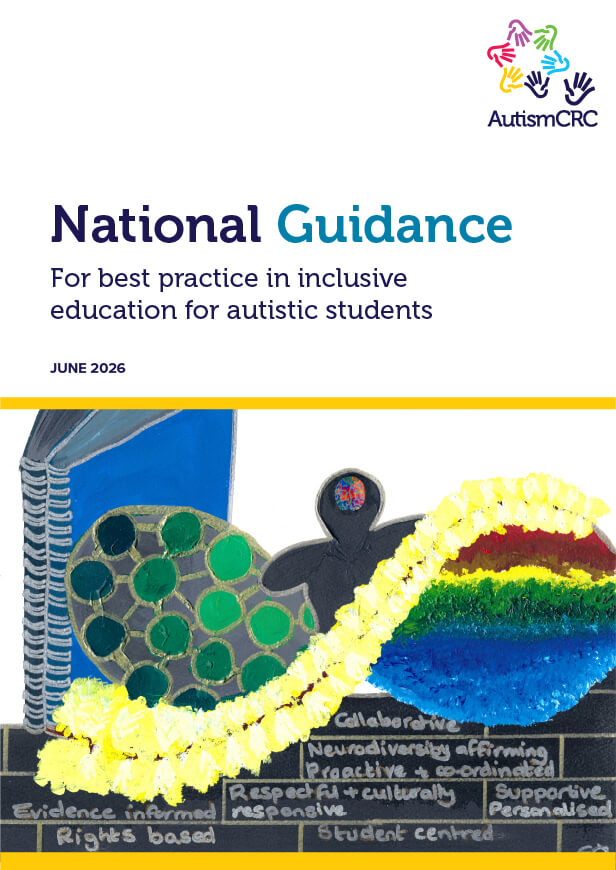
The National Guidance has nine Guiding Principles:
- Collaboration
- Evidence-informed practice
- Neurodiversity-affirming approaches
- Personalisation
- Proactive and coordinated action
- Cultural responsiveness
- Rights-based decision-making
- Student-centred and student-informed practice
- Supportive environments.
The National Guidance was co-produced with the stakeholder community. It is grounded in a rigorous methodology, informed by formal guideline development processes. It draws on:
- seven systematic literature reviews (64,434 articles screened; 507 included)
- a national community consultation involving more than 800 participants (including autistic youth)
- a Delphi study with experienced school leaders
- input and endorsement from a Guidance Development Group and Reference Group including autistic people, educators, parents, allied health professionals, First Nations representatives, and leaders from across Australian school systems.
The National Guidance focuses on inclusive education for autistic students in mainstream settings. It provides a clear, evidence-informed foundation for transforming school cultures and practices so that autistic students experience safety, belonging, engagement, and success.
Autism CRC funded the development of the National Guidance and its publication.